
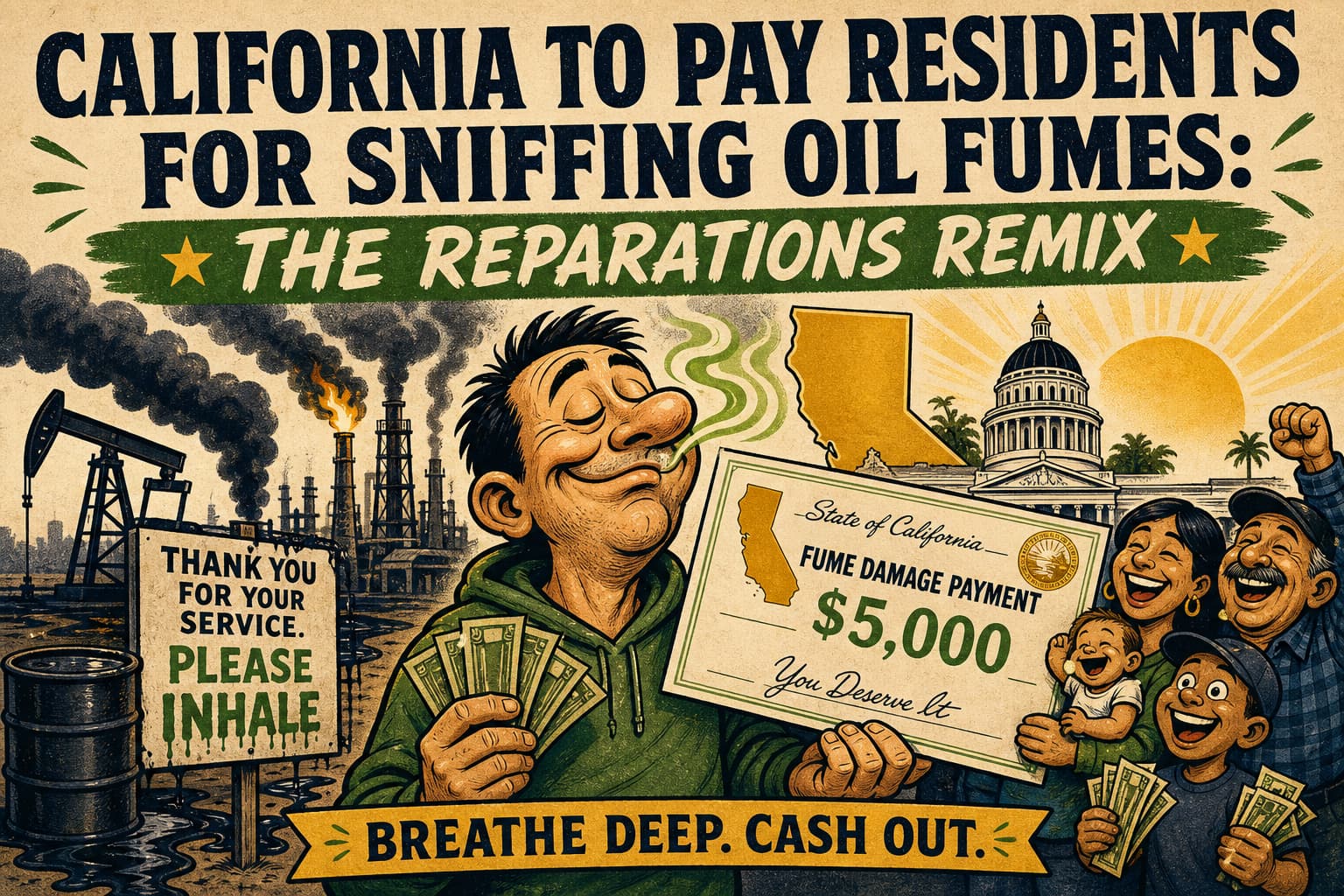
Residents of California, gird your nostrils and clutch your checkbooks: the Great Golden State is attempting to balance its karma ledger by doling out reparations for decades of olfactory insult. Imagine growing up with the scent profile of a malfunctioning deviled egg factory wafting perpetually through your window—forget Chanel No. 5, it’s Eau de Sulphur for everyone west of La Cienega.
Enter Regina, who as a child truly believed the rhythmic thumping of oil pumpjacks was as standard as bedtime stories or hiding under the covers from the boogeyman. Her parents didn’t warn her the only thing lurking was an industrial dragon exhaling the sweet whispers of future asthma attacks and mildly existential dread.
Fast forward to today, where the state’s lawmakers—presumably after a sage-burning session and a few rounds of competitive policy Tetris—have decided maybe, just maybe, citizens shouldn’t pay a respiratory fee for the privilege of existing near an oil geyser. “Hey, what if we refunded a few lungfuls’ worth of suffering?” someone suggested, right before calling the meeting’s snack break.
It’s not just any cash, mind you. This is penance-in-a-purse. Five million glorious, guilt-laden dollars, scraped up from the assorted couch cushions of penalized oil profits, to be squeezed into thousand envelopes, all addressed to households whose view includes both curb appeal and pumpjacks performing their interpretive dance of extraction.
The communities in focus—places like Inglewood, perfumed by hydrocarbons and blessed with property values that only a gopher could love—are now the testing ground for an experiment no Bond villain dared dream: reparations, California-style. That’s right. Practically everybody west of the 405 is on the verge of getting a check from the Department of Sorry-About-Your-Lungs, intended to mend not only hospital bills but perhaps also banish the eternal eggs Benedict aroma that haunted every family brunch.
The architect of this plan is Assemblymember Isaac G. Bryan, who has apparently never met a polluted air molecule he liked. His vision? A future where justice has a routing number and the phrase ‘environmental reparations’ becomes less about theoretical ethics textbooks and more about beefing up your direct deposit.
But will it heal generational psychic wounds? Will it restore time spent wishing for an ocean breeze instead of a whiff of motor oil soufflé? Can a single payment address decades where the only thing growing faster than children was the urge to move far, far away from the local refinery’s ambient perfume?
Environmental justice advocates stand ready with binders and probably at least twenty color-coded highlighters. They see this as a model, the environmental version of sending flowers after burning your neighbor’s lawn. If this works, the hope is to export the Atonement Express to every ZIP code where smokestacks are considered landscaping.
So, what lessons can be drawn from California’s gamble? Maybe, that sometimes reparations look less like a cavalry charge and more like a wave of checks fluttering through the air, scented faintly with the promise of a slightly less sulfurous tomorrow. Or maybe, that penance comes not in the form of grand gestures but in the humble, gas-scented envelope.
Either way, one thing is certain: the era of “we’ll make it up to you, honest!” has gone from hollow platitude to a line item in the state budget. And that, dear reader, is how you turn decades of asthma into something resembling progress. Or at least, into hilarious bureaucratic poetry.