
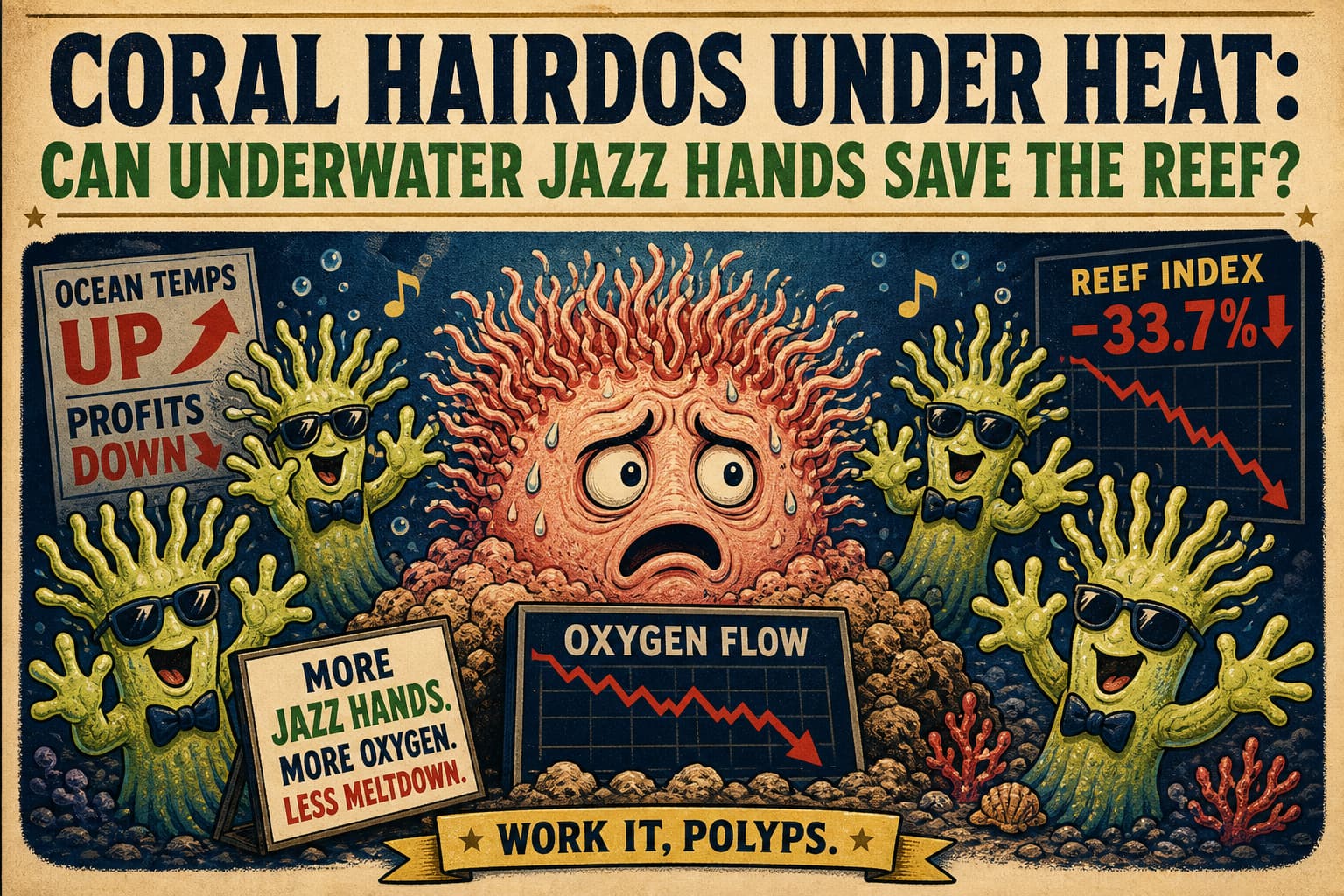
Headline: Coral Hairdos: When Tides Turn, the Struggle Gets Real
Let us all bow our heads in honor of the underwater divas, the corals. For years we called them rocks (the nerve!) while they were just sitting there, flamboyantly swaying and choreographing underwater musicals with their microscopic arm-hairs, living their best lives. Picture it: a coral colony is less 'dead mineral blob' and more 'underwater Studio 54,' where every polyp is feverishly waving its cilia, working overtime as if it’s auditioning for the lead mollusk in "Cilia on Ice."
But tragedy lurks! Poseidon’s sauna (aka our warming oceans) is now set on ‘extra crispy,’ and the corals’ little hair-dancers are flipping out, tap-dancing like caffeinated muppets at a disco. See, these coral cilia aren’t just for tickling passing plankton or brushing away bits of lost fish dandruff. No, dear reader, they are responsible for sucking in the one thing all living creatures need: sweet, sweet O2—delivered by swirling, self-fanned whirlpools more dramatic than anything on daytime television.
This Herculean effort used to keep the coral world oxygenated and pristine. At night, when the amoebic lights fade and the moonfish yawn, it’s up to these cilia to spin and twirl, bringing fresh air where algae left off. Imagine a thousand tiny Roombas caught in a perpetual jazzercise class—and their instructor just jacked up the thermostat.
But now, with the ocean about as cool as the inside of a microwaved burrito, the cilia are running a marathon in a sauna, frantically whipping up eddies that might as well be tiny water tornadoes named Mildred. And yes, they are gasping—if a polyp could gasp (which, trust me, it would). As temperatures rise, the stakes get higher. The cilia hustle harder, burning through oxygen like a marathon-runner overdosed on espresso shots, but there just isn’t enough juice left in the tank. The harder they work, the more exhausted, overheated, and ultimately—oh, the aquatic humanity—they suffocate.
It doesn’t end there. The whole affair has turned the scientific community into aquatic Sherlock Holmeses, peering through microscopes and arguing over whether the corals are more like Las Vegas showgirls or frazzled janitors. Team Biophysics shouts, "It’s all in the hydraulics!" Team Genomics screams back, "It’s the genes, darling!" Meanwhile, the mathematicians scribble feverishly on waterproof chalkboards, sketching out fractal equations that look suspiciously like a toddler’s attempt at drawing a seahorse.
But perhaps the greatest insult? Some corals are drama queens, turning ghostly white in the face of adversity (classic bleaching!), while others stand unbothered, sipping low-oxygen water cocktails and flipping their cilia with chilling nonchalance. Even side-by-side on the reef, one is mid-opera and the other is ice-calm, like Dwayne "The Rock" Johnson doing yoga next to your panic-prone aunt. The question on everyone’s lips: why?
In the end, our coral friends have fewer moves left than a sea cucumber at the disco. Their once-majestic cilia ballet is in trouble—and unless the oceans cool off or these underwater hairdos get an upgrade (deep-sea Dyson sponsorship, anyone?), the curtain may truly fall on the greatest silent-disco this planet has ever known. Stay tuned, aquatic fans: the next act features frantic scientists, existential coral crises, and—just maybe—a plot twist to save our submerged soap opera.